


EXPANDED PRACTICE 4
It's all coming together...
Practice journal for Expanded Practice 4

NOTICE
It has been brought to my attention that the full details of this journal may not be immediately apparent to viewers. Due to time restraints I have been unable to change the layout for better readability. Please note that many of the images below will have descriptions of the process visible is they are hovered over or clicked on. Thank you.
EXHIBITION DESIGN: 2D

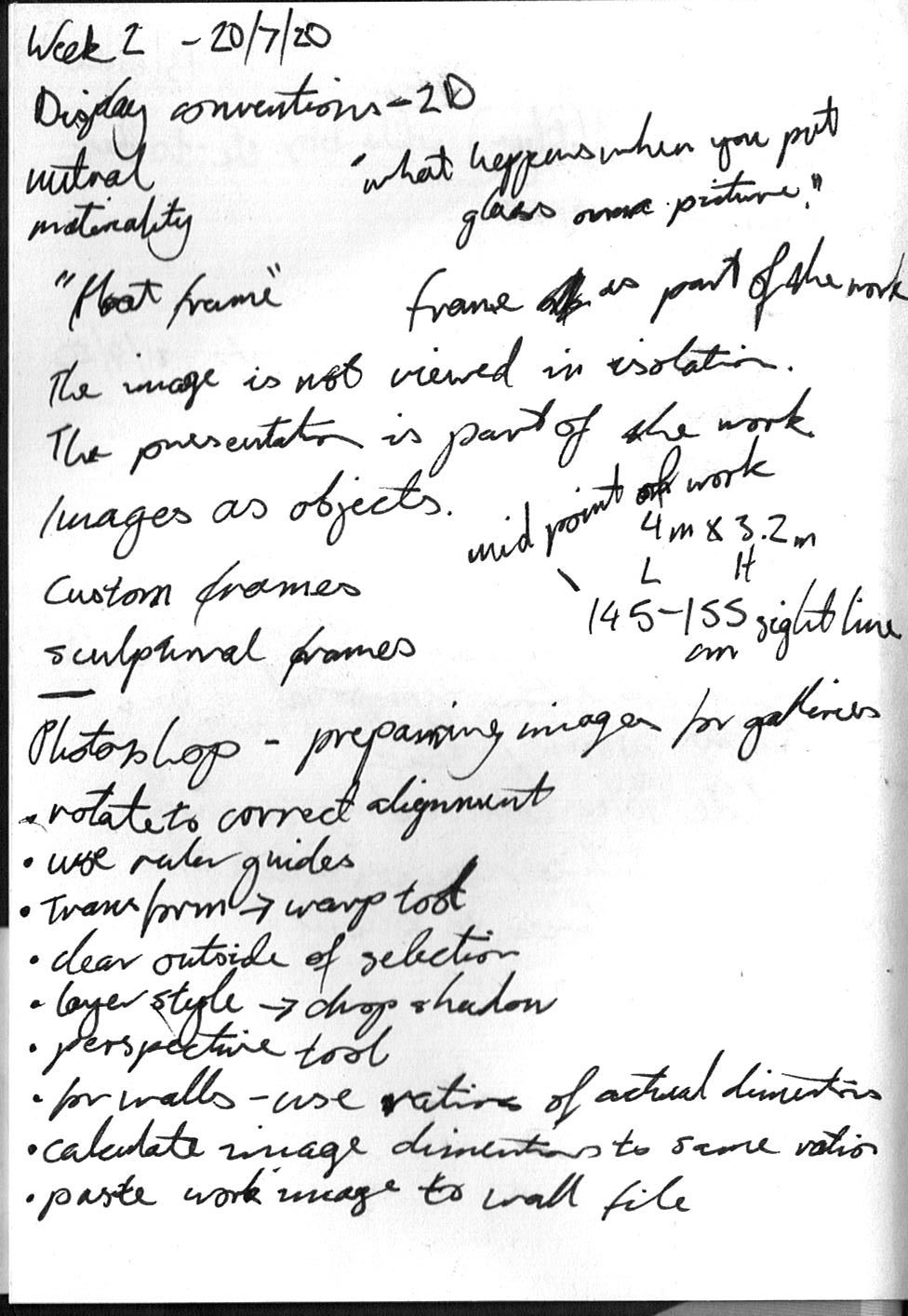

Having seen these works in person, I was better able to visualise the space.

Portrait of my parents from a few years ago. Learning to photograph and alter photos will help me a lot in documenting these works in future.

This image is compiled from a number of scans of the work.

I have had a lot of trouble photographing this work and even with the new techniques for realigning it, I'm still struggling with the light reflecting off the paint.

I edited out Natalya's all work (I left in the floor sculptures because I think they make the image less clinical and sterile). I added a drop shadow to the works but they still look a bit funny because there's no depth to them.
EXHIBITION DESIGN: 3D

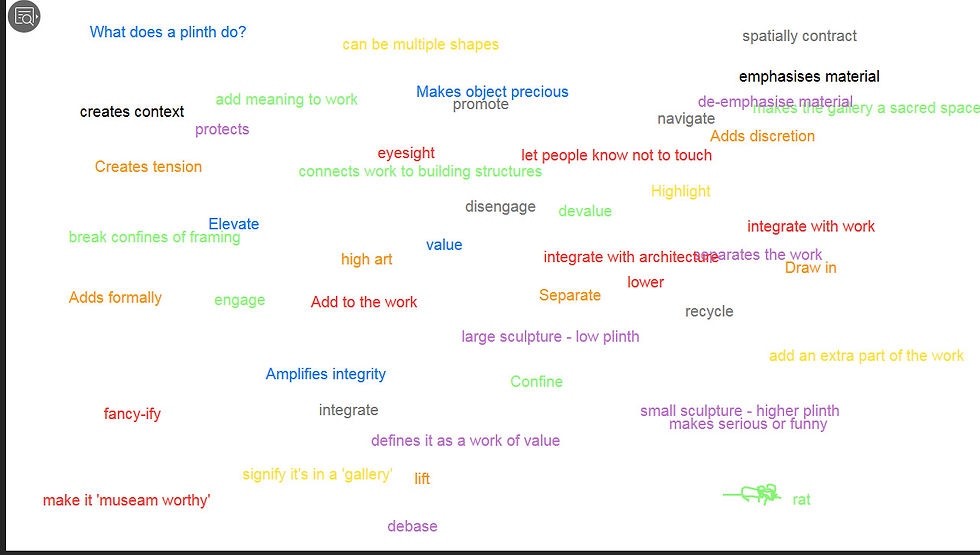


I originally included this, believing it was a mosaic tile sheet. Now having learned more than nothing about tiling, I was mistaken and am somewhat embarrassed. See below for actual tiles I would use.
EXHIBITION DESIGN:
Moving Image and Sound and Performance


There was a lot of information here I wasn't prepared for. I'll need to do a lot of research before proposing work with these technologies in future.

Again, the technical aspects of presenting and documenting these works was a lot for me to take in.
EXHIBITION DESIGN:
Museum/Set/Decor and Misc notes


Artist Statement Task
Artist Statement- Hand Washing Techniques
Initial Statement
Hand Washing Techniques is a series of seven sculptures cast from soap in the shape of hands in the process of washing. In a world forever altered by the emergence of COVID-19 a new paradigm in personal hygiene has developed. Anxiety, apathy and exhaustion entwine in our collective consciousness around the act of handwashing. This series engages with the materiality of soap and the ritualised nature of the previously mundane practice of hand washing. The sculptures are displayed both on plinths and on wall mounted mirrors in the style of a public bathroom. Upon entering the space the audience is asked to engage by physically washing their hands using one of the works selected from the plinth displays. This sets the tone to explore the works as a whole. Each mode of display highlights a different element of the works. Upon the plinths, the works are displayed as art objects. The sculptural forms are displayed in a formal way. The work upon the walls works best to activate the work as a series of performed actions. That element is also presented in the participation in hand washing but its main focus is to engage with the material of soap. The material nature, physical action and sculptural forms work together to create a work that offers the audience a heightened awareness of our everyday rituals.
Conversational Statement
I’ve made a bunch of sculptures shaped like hands made of soap. I made them using the steps laid out in the infographics you can find in public bathrooms. COVID-19 has made handwashing feel really important and I wanted to make people think about that. I thought using soap would offer an interesting way to encourage people to look at the sculptures. I show them sitting on plinths but also coming out of mirrors on the walls. One way shows them looking like you’d expect sculptures to look, the other way shows them like they’re coming at you, coming into your space. I’d also set up a couple of sinks at the gallery door so people have to wash their hands when they come in. When they do, one of the sculptures will be moved from the plinth to the sinks so they wash their hands with my hands! Just getting people to think about soap and personal hygiene.
Refined Statement
Kitten Xaos made a series of sculptures shaped like hands made of soap. They were made using the steps laid out in the infographics one can find in public bathrooms. COVID-19 has heightened the importance of personal hygiene and this work explores that relationship. The novelty of the medium of soap offers a point of interest, encouraging viewer engagement with the sculptures.Their placement on the plinth plays into the conventions for display of the art object. The use of mirrors, the semi gloss finish to the plinths and the hastily laminated info charts offer hints of the bathroom setting inspiring the series. Each work presents an action in stasis, together they play like a spot motion loop of our new global obsession. The material nature, implied movement and sculptural forms work together to create a work that offers the audience a heightened awareness of our everyday rituals. Hand washing techniques with and by soap.
EXHIBITION DESIGN ASSESSMENT
A Guide to Hand Hygiene

The info graphic that inspired it all!

Forgot to take more shots during construction. The weight held down the corner while the glue dried. Note the additional corner supports as recommended by Natalya.

Tile pattern I mutlipled and shrunk before printing and gluing to the miniature plinths.
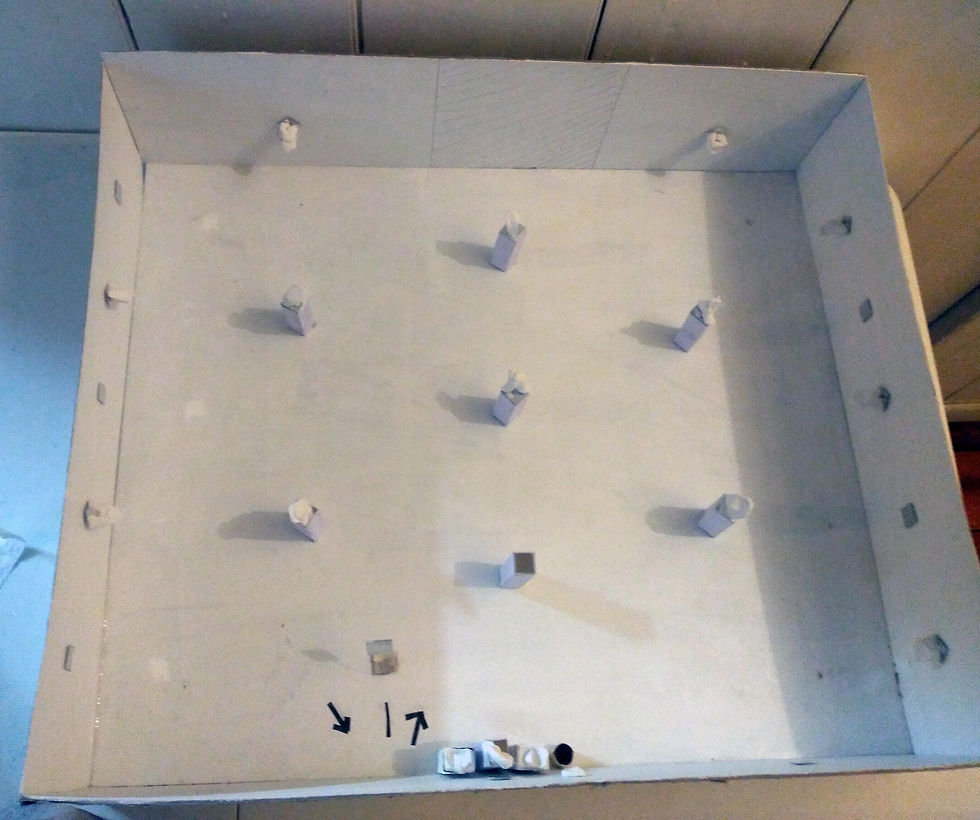
I had initially chosen the Grey Street Gallery as I'm most familiar with it's layout. After consider how I wanted the work to be see, I changed to the Webb Gallery. I went to the gallery and took photos inside, trying to take in the space as much as I could for my work.

Unfortunately when drawing up the cardboard with the dimensions for the Webb Gallery, I became very confused by the measurements given and had to choose another at short notice. After consulting with the class, I chose Outer Space's old Gallery 1 for its large, open area that would give each work it's own space.

The first set of hands I made were far too large for a workable scale so I remade them as small as I could. They were still much larger than scale, but I did my best with the air dry clay that I'm not super familar with.


The cat walked on the paint while it was trying. Even with a second coat, it was visible is some spots. Jerk cat.

Exhibition Outline
A Guide to Hand Hygiene
A Guide to Hand Hygiene aims to exhibit two sets of a series of seven sculptural works of approximately 30 centimeters squared. One set to be displayed on tiled plinths, the other set on mirrors on the walls. The works highlight the performative nature of our new hygiene paradigm and the newly exalted materiality of soap, of which the sculptures primarily consist. The old Outer Space gallery 1 offers a good location for the exhibition that would use the large, unobstructed space to lay out airs of a public bathroom. The public bathroom is the chosen setting for the exhibition as it is where one can find the printouts of new icons for the hand washing techniques after which the sculpture series has been modeled and named. Portable sinks will be provided and the audience will be directed to “wash hands before entering”. Participants will have access to physically wash their hands using one of the soap sculptures, rotated between the works displayed on plinths. When a work is removed from the plinth and its place as art object and converted into cleaning material the plinth will remain with a sign reading “Art work has temporarily been removed for cleaning.” A Guide to Hand Hygiene looks to create a space where the audience can be fully immersed in and aware of the actions and materiality of one of the rituals of a post COVID-19 world.
Technical Requirements
30x30x100cm tiled plinth x8
30x30cm acrylic mirror x7
A4 Foyer Stand x1
Portable Sink x2
Cleaning Sign x1
Hand Towel Dispenser x1
Waste Bin x1
A3 Print out of hand washing poster x1
1. Tiles sources from https://www.bunnings.com.au/dta-300-x-150mm-mosaic-tile-spacer-sheets-10-pack_p0069551?gclid=CjwKCAjwnK36BRBVEiwAsMT8WGDfCNY4zWBNt-wokq8wZrvT2rjy4-6kUVhtb_AP6sIF2UA0JFZBPxoCI6cQAvD_BwE&gclsrc=aw.ds
2. Sources from https://www.bunnings.com.au/edge-300-x-300mm-square-acrylic-mirror_p1730154
3. Sources from https://www.slimlinewarehouse.com.au/foyerstand/dy07a4sv.aspx
4. Sourced from https://www.transplumb.com/for-business-3/cosmetic-and-health-services-1/medi-sink?gclid=Cj0KCQjw-af6BRC5ARIsAALPIlWkEyGPjTcw6rnfcZk3bgtTSuIK9iYaurP-UKp0-yFIMugS1xA56IMaAlHaEALw_wcB
5. Sourced from https://www.bulkbuys.com.au/products/door-hanging-caution-sign-closed-for-cleaning?variant=34805251375265&utm_medium=cpc&utm_source=google&utm_campaign=Google%20Shopping&gclid=CjwKCAjwnK36BRBVEiwAsMT8WLJ9dIc4qe0fE67IPcdaDDswUgdUWiNuqdcf7CQfivtDGBPMj6YNuxoCNz0QAvD_BwE
6. Sourced from https://www.ozwashroom.com.au/t501-compact-paper-towel-dispenser?gclid=CjwKCAjwnK36BRBVEiwAsMT8WL97DccLIWoSMW9Mujiw5wR1Hsxei_eyyG7fR8GOAiteKtYLbD4BjBoCdaAQAvD_BwE
7. Gallery Supplied
8. Downloaded from https://www.debgroup.com/sites/default/files/uploads/attachments/hand_washing_technique_1.pdf
RESEARCH
BASICS OF COLD PROCESS SOAP MAKING
This is one of many videos I watched before trying soap making and offers one of the best examples of the technique I employed in my project.
SOAP CALCULATOR
Made by the same creators of the videos above, this browser app automatically calculates the weight of lye (sodium hydroxide) needed for saponification based on the weight and type of oils used.
SOAP ART
While conceptual art works involving soap have proven illusive (bar Janine Antoni's Lick and Lather) the artisinal soaping community has excelled in techniques of pouring and carving to create visually stunning pieces.
Savvas Papasavva
This is your item description. Use this space to add a description of the services, products, team members or any other items you want to highlight on your site. Have a lot to say? Easily turn any item into a full page by clicking ‘Create a page from this item’ in the edit panel.
MATERIALITY- DOCUMENTS OF CONTEMPORARY ART
Petra Lange-Bernt, Introduction// How to Be Complicit with Materials and Monika Wagner, Material, 2001
(I am annotating these two together because I did not make notes about them separately at the time and have forgotten which text mentions specific ideas)
Dense text discussing the nature of materiality. The need to liberate materiality from form. The parallels between the feminine material and the masculine form. Others talk about connecting with material and making it 'sing'.
This made me think about how the method of display effects the audience's perception of different elements. I asked myself what the subject and what the medium is for my work. Is the action the subject with soap the medium? Or is the action a vehicle to discuss the properties of soap? I decided that each element had value to offer the audience and thus devised multiple displays to highlight the work differently.
It is unfortunate that it is unfeasible to show the sculptures with running water. Because of it's chemical structure, it is impossible to fully understand soap without its interaction with water.
MATERIALITY- DOCUMENTS OF CONTEMPORARY ART
Artur Barrio, Manifesto, 1969
Barrio talks about dematerialising art as a way of leveling the art field for creators who cannot afford the artist quality materials that are industry standard. He talks about doing away with the art object altogether, with the artwork's shadow only existing through documentation.
I have thought a lot about the choices I've made in making this work. As an art student/pensioner, the mutli-hundred dollar bills for materials have been eye watering. But at the same time I understand how privileged I am to be able to pay them at all. I simply couldn't have made this work on AusStudy alone and admire the ingenuity of my fellow students who are working with significantly greater financial pressures.
OBJECT- DOCUMENTS OF CONTEMPORARY ART
Theodor W. Adorno, On Subject and Object, 1969
Heck, was this a lot. I think it was talking about how asserting the prevalence of one (subject or object) over the other the thing and that both must be considered as part of the whole to complete the work.
Item Subtitle
I've been keeping an eye on the site. Interesting how some shows engage their space and others are so uninspired.
How can galleries all over the world be so different, yet all kinda look the same? I wonder if they smell the same?

SELF DIRECTED PROJECT
Hand Washing Techniques
PROCESS GALLERY
Plaster Castes

I switched to green alginate as it has a faster set time. It still hurt a lot waiting for it to set.


The plaster came out with varying imperfections due to the reduced size of my mould as per EP 3.

Yikes! Those air pockets!


As per the first set, each plaster cast was sanded and patched with clay, ready for silicone.
PROCESS GALLERY
Silicone and Plaster Wrap

Each plaster caste takes about four tubes of silicone to build up a suitable skin to mould with.

I used the upturned plinth I built with Andrew as a box for my silicone. Blue bucket contains very soapy water.

Kneading the silicone in soapy water catalysis the curing, turning it into a suitable moulding putty.

After curing for at least a day the silicone/plaster lump is wrapped in cling film before plaster wrapping. I used strips of old clothing, kindly donated by the rats from their surplus bedding pile.

Each hand mould lump was plaster wrapped half way then left to dry.

Once the first side had cured a generous layer of patrolium jelly (that's vasiline to you and me) was applied along the edge. This created a barrier for the plaster of the second half so the mould doesn't stick together.
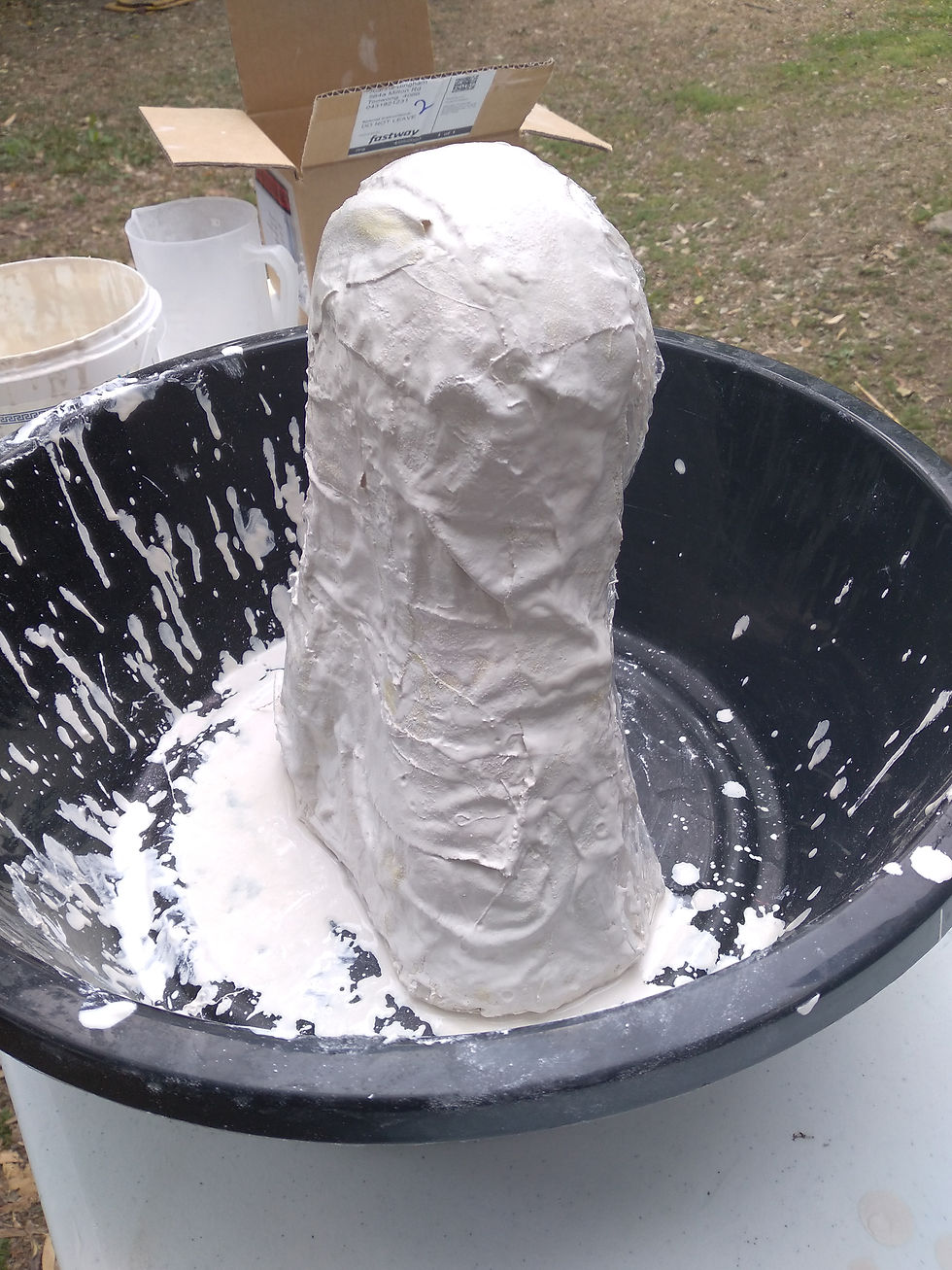

Once the second half cures it can carefully be pulled from the hand blob.

With both plaster wrap halves off, the cling film can be removed and the silicone skin cut to release the caste within.
PROCESS GALLERY
Soap Caste and Carving
%20skin.jpg)
After slicing and peeling the silicone from the plaster it's washed and dried to remove most of the plaster and clay residue.
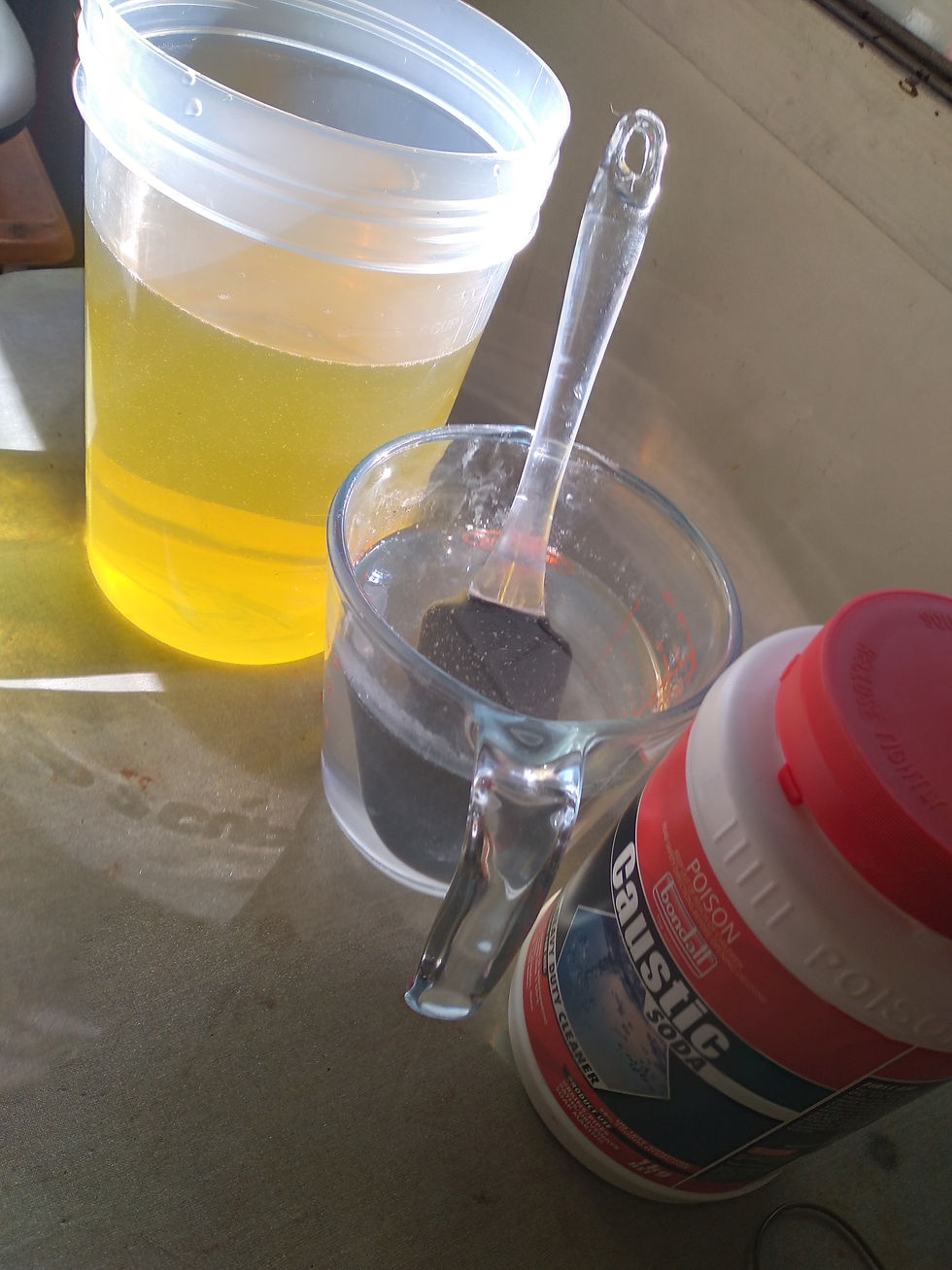
Things about to be soap.

The silicone held back together with tape and encased in the plaster wrap then held upright with a bucket and a shapes box, the soap was poured.

The first two castes held together with minimul leakage, but the third was a different story. The soap batter flowed out of the silicone and plaster and filled the bucket. After several unsuccessful transfers back and forth between buckets and a lot of raw soap on my hands, I managed to contain it with cling film again and keep the soap where it was meant to be.

Got some mild l burns from the soap batter and partcially melted my finger nails. But what's a few chemical burns between friends?

Soap, not escaping it's plastic wrapped tomb.

The soap was left at least 36 hours to set in the mould. After removal it was left to dry another 24 hours before carving.

I was lazy with the silicone kneading this time around and learned that the silicone sticks to the plaster if it isn't kneaded propperly before applying. Some castes needed a lot more work than others.

A gecko laughed at me when I set this up after carving. Can't please everyone.
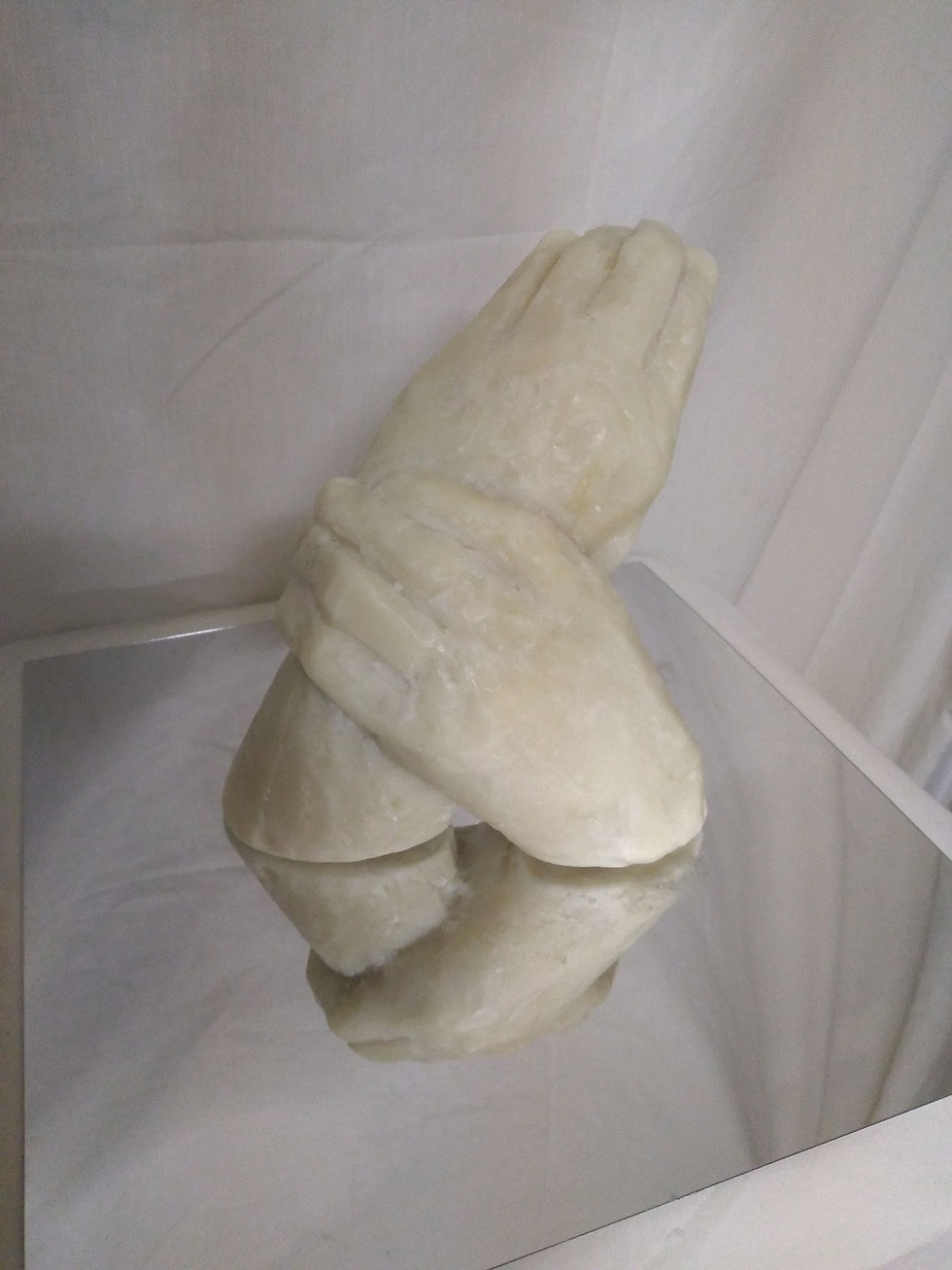
Had to carve out the fingers a bit on this one.
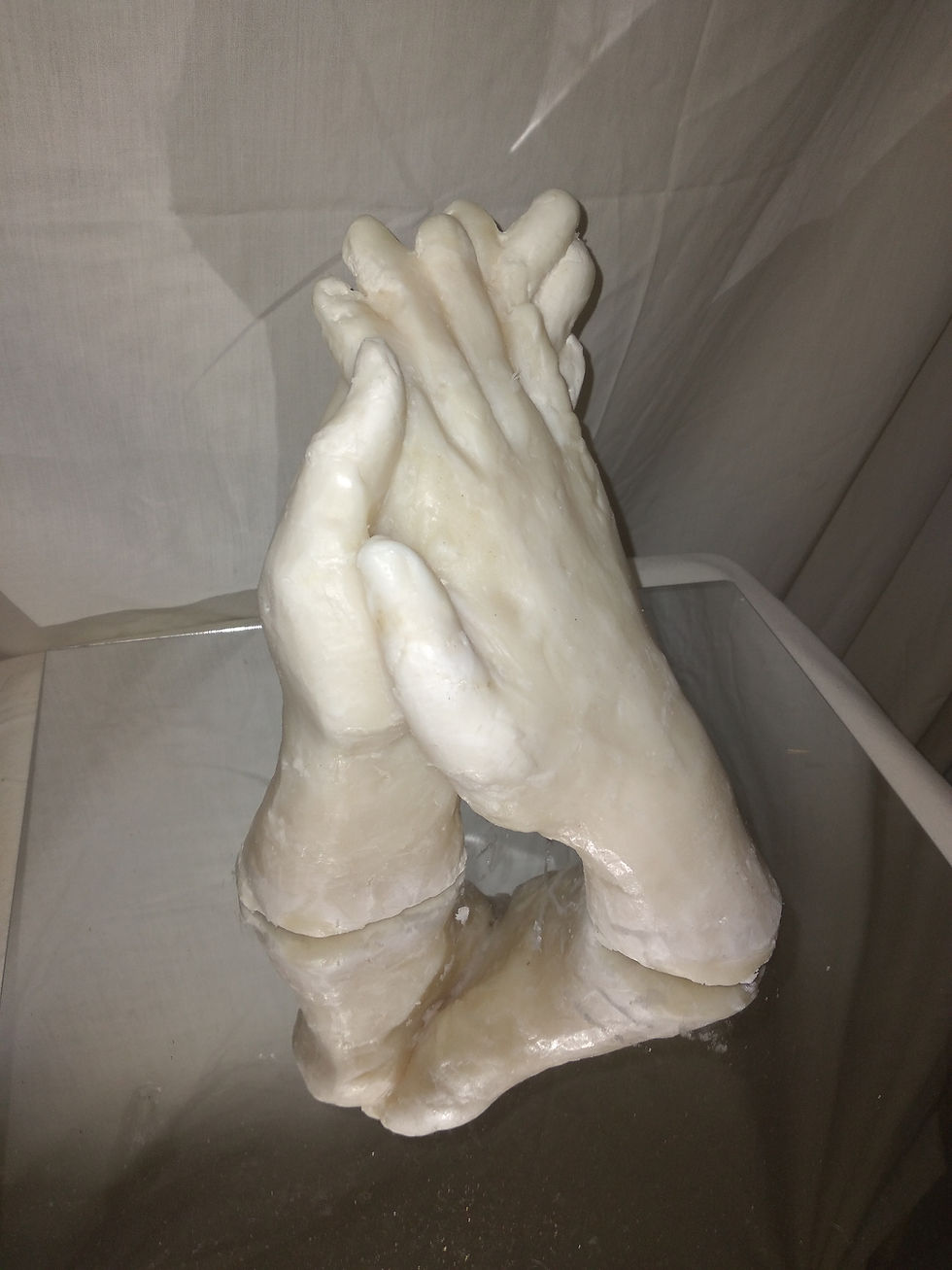
This one and 4 needed the most work carving out the finger definition.
PROCESS GALLERY
Plinth Building

Pile of MDF in front of three constructed plinths.

This square clampign tool was invaluable as I glued and bradded the four walls of the plinths.

I started off using the palette thing to apply the spakfilla but ended up using my fingers as I felt I could control the material better and had less wastage.

I used 6mm MDF which would be too thin to securely attach on its own, so I added small lengths of timber at the corners to increase surface area for the glue. This offered a light weight option without the technical proffisiency requires for an internal frame.

All seven plinths waiting to be sanded.

I used both a belt sander and manual sanding to finish off the plinths.

My seven plinth children, naked and ready for their undercoat.

Seven undercoated plinths ready for their top coat.

I chose a semi-gloss for these plinths (bathroom feel). It took three coats to bring up the gloss to a consistent coverage.

Tile options for potential future plinth tiling.

It was financially unviable to tile my plinths at this stage.

The bag was moving very fast, it wasn't just my shakey hands.

The grout moved fast as well...
PROCESS GALLERY
Display Design and Install

Quickly tested how the scupltures looked on the plinths in the River Studio.
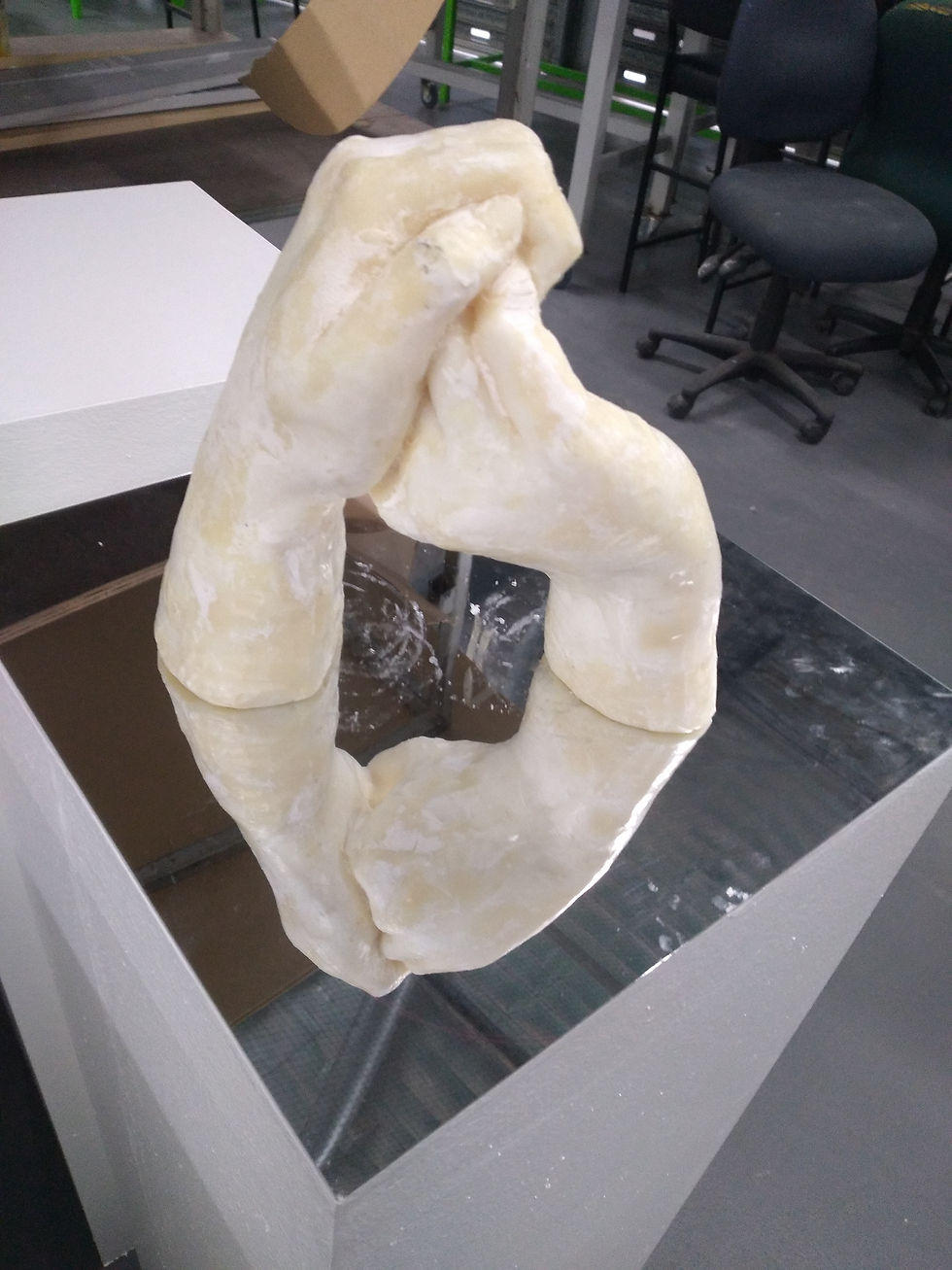
I wanted to see how they would look on the plinths before install. I'm happy with the mirror effect.

Unfortunately this version doesn't show one of the steps I had cast or I would have considered renumbering my pieces to fit the Griffith hand washing guide.

The class agreed to plan out our work placement ahead of time so we weren't fighting for space so much. I still think we may need to swap some works out.


PUBLISHING SHOTS

Too tired to edit photos from today for this section.

Will edit shots from above section for colour correction in the next few days.